
知乎
$5,000 grew into a forest: American donor returns to China to reunite with desert reclamation partner_我的网站

一 |
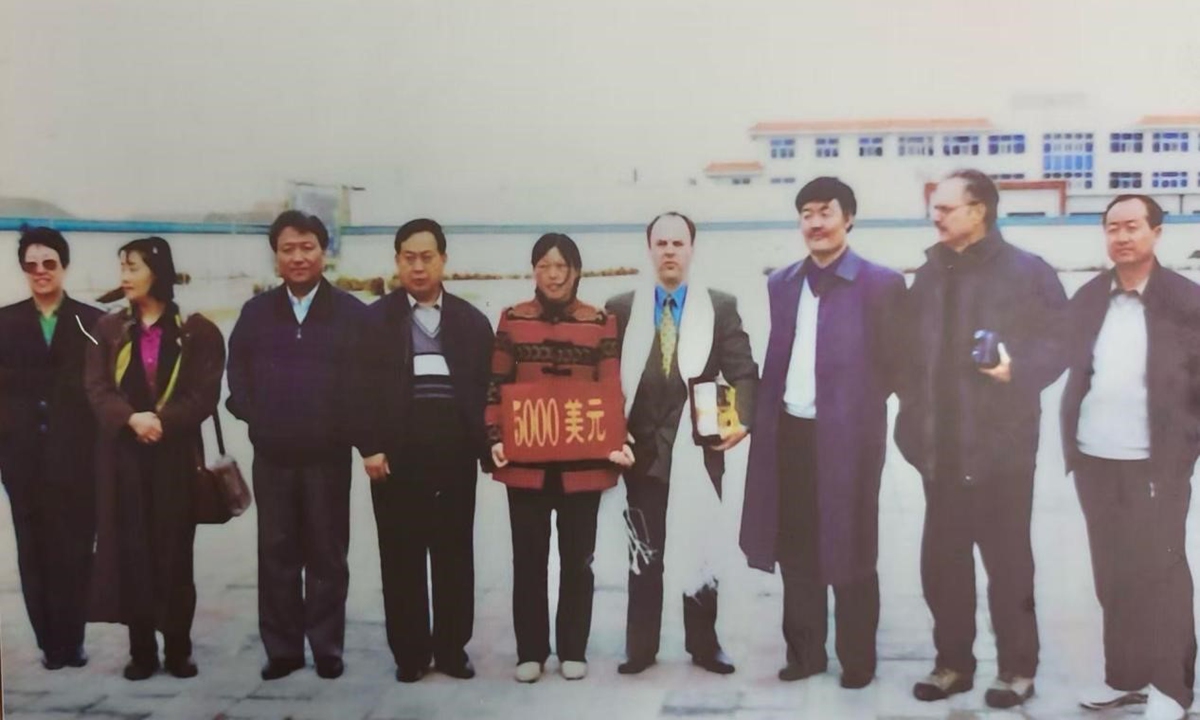
At 2:48 am on early Sunday morning, after a flight of more than 10 hours, Ronald Sakolsky arrived at Beijing Capital International Airport. As he stepped into the arrivals hall, he greeted the waiting reporters with earnest Putonghua "Wo hui lai le," meaning "I'm back."
The thrill of his homecoming had washed over him most vividly during the final moments of his flight. "When I saw the lights in Beijing as we were landing is when I realized that I am back in my second home."
Sakolsky, an American retired teacher from Pennsylvania, is visiting China from Sunday to September 1 for a journey that will take him to Beijing, North China's Inner Mongolia Autonomous Region and Central China's Henan Province. It is a reunion nearly three decades in the making.
That reunion began with a single act of generosity. In 1999, when Sakolsky arrived in China as a participant in a bilateral teacher exchange program, he was moved by Yin Yuzhen and her husband's tireless efforts to curb desertification in the Mu Us Desert in Inner Mongolia. He raised $5,000 to fund their local tree-planting initiative. The young saplings bought with the donation have since matured into more than 50,000 full-grown trees, transforming the once desolate, sandy wasteland into a thriving green landscape.
After decades of lost contact, Yin, a national model worker renowned for her desert restoration achievements, launched an online search for her American benefactor in May, hoping to reconnect with the man who helped launch her lifelong desert reclamation mission.
What followed was a remarkable wave of online support: within less than 48 hours, a nationwide search had tracked Sakolsky down. That swift effort led to their long-awaited virtual reunion, a video call that brought them face to face for the first time in 27 years.
Asked what he is most looking forward to about this journey, Sakolsky told the Global Times that "I want to see Ms Yin, see the forests, see the students I have not seen for almost 30 years, my colleagues. I want to see the Chinese people."
The trip itself felt like a dream he never thought would come true, he added.
Now, the dream is about to come true. Later on Sunday, Sakolsky will fly to Ordos, Inner Mongolia, the site of the transformative environmental project that bound his fate with Yin's all those years ago.
During his China visit, Sakolsky will join Yin in a new tree-planting activity. He will also hold exchanges and discussions with teachers and students from the Luoyang No.2 Foreign Language School where he once taught, and participate in official China-US teacher exchange events, according to the Xinhua News Agency.
As he prepares to see the transformed landscape with his own eyes, Sakolsky shared with the Global Times about how much China itself has changed over the past two decades. From photographs, he said, he had already seen the barren desert he remembered turn into lush green forests; he had also heard that Luoyang has become far more vibrant and beautiful.
"Hopefully the message gets out to the world that Chinese and Americans can work together and make a peaceful world," he said.
。 The debate around cinematic narratives and representation has taken a personal turn as Diljit Dosanjh recently shared a hard-hitting post on his Instagram stories. He shared a report highlighting the stark contrast between the reception of mainstream patriotic films and the ongoing struggle of his long-delayed biopic, Punjab 95. The post shared by Diljit draws a direct comparison between how certain roles are celebrated versus others that face hurdles. It points out that while Diljit receives widespread acclaim for his participation in high-profile patriotic projects like Border 2, his work on the biopic of human rights defender Jaswant Singh Khalra remains in a state of limbo. The shared content notes that Punjab 95 has been stuck with the CBFC (Central Board of Film Certification) for three years. This delay stands in contrast to the rapid success of other contemporary releases, such as Dhurandhar: The Revenge, which the post mentions is being celebrated even as Punjab 95 continues its battle with the censor board. Punjab 95, directed by Honey Trehan, delves into the life of Jaswant Singh Khalra and his investigations into sensitive historical events in Punjab. The film has reportedly faced demands for extensive cuts and changes, preventing its domestic release for almost 36 months. The post suggests a perceived disparity in how the film industry and regulatory bodies treat different types of stories. While films that align with established nationalistic themes often find a smooth path to the audience, biographical stories that explore complex human rights issues or historical grievances seem to face a much more rigorous and prolonged screening process. By sharing this specific critique, Diljit Dosanjh aligned himself with the conversation regarding creative freedom and the importance of telling diverse stories. For now, the contrast between the celebrated mainstream cinema and the stalled biopic of Jaswant Singh Khalra continues to spark a debate about the future of storytelling in Indian cinema. Also Read: Border 2 OTT Release: When & Where to Watch Sunny Deol’s Film?。
Current article:http://k82di.taokenlaichunlei.bond/zc7o5/4074.html
Published on:10:01:28